
Property Investment in Coventry
LAT Property Investments providing exciting property investment opportunities in Warwickshire with investment entry levels from £20,000+
Sourcing Property Opportunities Across England
Investment from £20,000 with various return options
Working with Experienced Investment Professionals and Novices
Coventry Property Investment
Coventry presents property investors with an intriguing Midlands proposition—affordable entry pricing combined with genuine transformation momentum, major university presence, and improving transport infrastructure creating balanced opportunities for those seeking value positioning with growth potential. The city sits in transition between its industrial heritage and emerging knowledge economy identity.
Property prices averaging £130,000-£160,000 for investment-grade houses require deposits of £33,000-£40,000, positioning Coventry between Derby's budget accessibility and Birmingham's premium pricing. These moderate entry costs deliver gross rental yields of 6-8% for standard buy-to-let, extending to 9-11% for well-positioned HMO conversions near universities—returns combining immediate income with reasonable capital appreciation prospects.
Coventry's economic landscape has evolved substantially from its automotive manufacturing dominance. Whilst Jaguar Land Rover maintains significant presence and the automotive sector remains important, the city increasingly focuses on higher education, healthcare, digital sectors, and professional services. Coventry University alone enrolls over 38,000 students (including satellite campuses), creating substantial accommodation demand supporting diverse rental strategies.
The city gained international profile as UK City of Culture 2021, driving regeneration investment, cultural development, and reputational enhancement. Whilst immediate culture year impacts have passed, infrastructure improvements, residential developments, and ongoing regeneration projects continue transforming previously neglected areas.
Transport infrastructure strengthens Coventry's fundamentals—direct rail connections to London (under 1 hour), Birmingham (20 minutes), and other major cities, M6, M40, and M69 motorway access, and Birmingham Airport proximity. HS2's planned Interchange station near Coventry Airport would further enhance connectivity, though timeline uncertainties require investing based on current rather than speculative future infrastructure.
Coventry demonstrates measured capital appreciation historically averaging 3-5% annually—respectable without being exceptional—alongside solid rental demand creating balanced return profiles. The city attracts investors seeking Midlands exposure without Birmingham's premium pricing or Derby's extreme budget positioning, and has emerged as one of England's most compelling regeneration stories, transforming from industrial decline to cultural destination whilst maintaining property prices that reward early investors
Key Coventry Neighborhoods for Investment
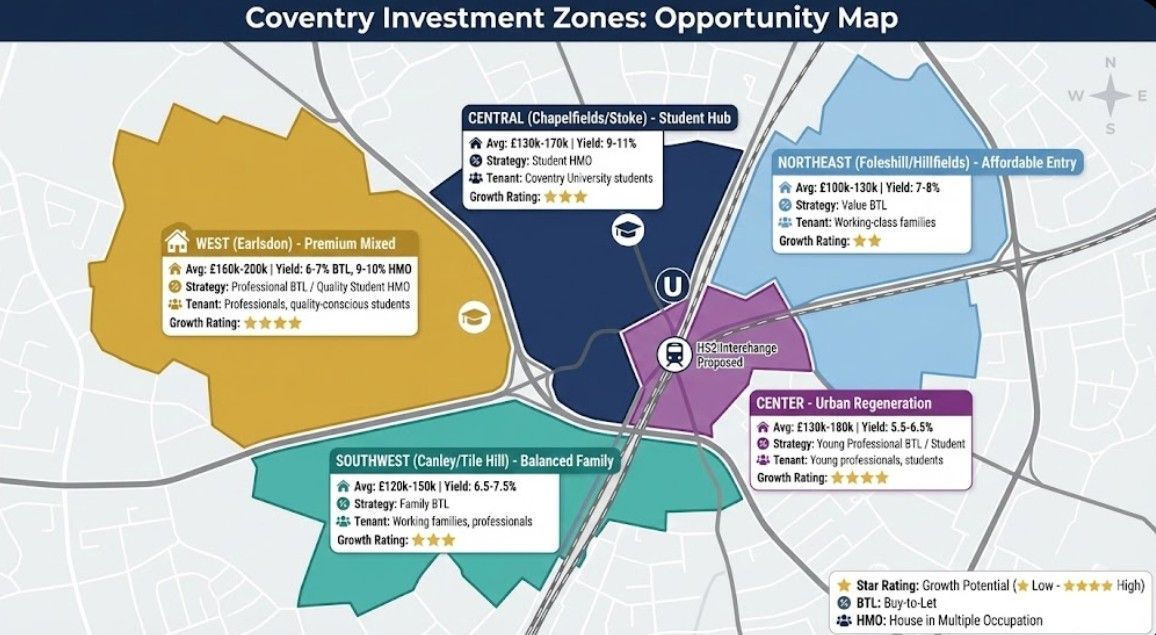
Coventry's compact geographic footprint creates accessible investment zones, each suited to particular strategies and tenant demographics.
Earlsdon (Premium Residential and Student)
Earlsdon represents Coventry's most established and desirable neighborhood, combining village atmosphere with city proximity. Victorian and Edwardian terraced houses typically cost £160,000-£200,000, generating 6-7% gross yields for professional single-lets or 9-10% as student HMOs. The student market operates at smaller scale than Nottingham's extensive accommodation infrastructure, but lower competition and entry costs create attractive risk-reward profiles for experienced HMO investors.
The area benefits from independent shops along Earlsdon Street, community character, and appeal to both young professionals and students seeking quality accommodation. Properties work for multiple strategies - family lets to professionals, student HMOs, or young professional house shares - providing operational flexibility.
Earlsdon demonstrates strongest capital appreciation prospects within Coventry given its established desirability and limited new development potential. The neighborhood suits investors accepting Coventry's premium pricing in exchange for best-in-city tenant demographics and growth potential.
Chapelfields and Stoke (Central Student Zones)
These areas adjacent to Coventry University city center campus provide core student accommodation territory. Terraced houses typically cost £130,000-£170,000, delivering 9-11% gross yields when fully tenanted with 5-6 students paying £280-£350 monthly per room.
Chapelfields particularly benefits from immediate campus proximity and established student infrastructure. Stoke sits slightly further but maintains strong student appeal with more affordable property prices creating superior yield potential.
Competition from purpose-built student accommodation intensifies in Coventry as elsewhere, requiring realistic expectations. Quality properties in prime locations near campus continue letting successfully, whilst peripheral properties face increased challenges securing tenants against modern purpose-built alternatives.
Canley and Tile Hill (Southwest Corridor)
Southwest Coventry neighborhoods provide balanced opportunities—property prices £120,000-£150,000, yields 6.5-7.5%, and mixed tenant demographics including working families, young professionals, and some students attending University of Warwick's nearby campus.
These areas benefit from reasonable local amenities, Canley train station providing direct London services, and University of Warwick proximity (technically outside Coventry boundaries but functionally connected). Properties suit straightforward buy-to-let strategies targeting stable family tenants.
The southwest corridor represents solid middle-market territory suitable for investors seeking Coventry exposure without premium Earlsdon pricing or intensive student area management.
Foleshill and Hillfields (Northeast Affordability)
Northeast areas offer Coventry's most accessible entry points—properties from £100,000-£130,000—delivering gross yields potentially reaching 7-8% to diverse working-class tenant populations including families and some benefit recipients.
These neighborhoods require careful property and street-level selection. Some streets demonstrate stable demand and reasonable conditions; others face persistent challenges around property maintenance or limited amenities. Thorough due diligence prevents investing in superficially attractive high-yield properties in fundamentally problematic locations.
Northeast Coventry suits experienced investors comfortable with higher-yield, higher-management strategies rather than first-time investors seeking straightforward passive income.
City Center and Regeneration Zones
Coventry city center has experienced substantial regeneration including residential developments, student accommodation projects, and commercial improvements. Modern apartments typically cost £130,000-£180,000, generating 5.5-6.5% gross yields to young professionals or students.
City of Culture legacy includes improved cultural venues, public realm enhancements, and ongoing development projects transforming previously underutilized areas. However, city center apartment markets demonstrate mixed performance—some developments let successfully, others struggle with tenant demand or management issues.
City center investment suits those wanting urban regeneration exposure at Midlands pricing, though opportunities lack the scale and momentum of Birmingham or Manchester regeneration zones, Coventry's regeneration benefits significantly from proximity to Birmingham's economic expansion just 19 miles south. Improved transport links and Birmingham's growth overflow create genuine investment fundamentals beyond simple regeneration speculation
Why Coventry Attracts Investor Interest
Coventry's investment appeal stems from transformation momentum and future potential rather than current perfection—understanding this trajectory-based positioning prevents unrealistic expectations whilst recognizing genuine opportunities.
City of Culture Legacy
UK City of Culture 2021 delivered tangible benefits beyond temporary cultural programming. Infrastructure improvements including public realm enhancements, cultural venue upgrades, and residential developments created lasting physical improvements. Reputational enhancement challenged historical perceptions of Coventry as purely industrial city, attracting increased visitor interest and business attention.
Whilst immediate culture year impacts have moderated, ongoing regeneration projects continue transforming city center and surrounding areas. Cathedral Quarter improvements, waterfront developments, and residential construction demonstrate sustained investment confidence extending beyond temporary cultural focus.
University Growth and Expansion
Coventry University's substantial growth over recent decades—from modest polytechnic to major institution enrolling 38,000+ students—fundamentally altered the city's character and economy. The university continues expanding facilities, developing satellite campuses, and attracting international students creating sustained accommodation demand.
University of Warwick, whilst technically outside Coventry boundaries, functionally connects to the city and contributes to regional student accommodation demand. Combined enrollment exceeds 60,000 students providing substantial rental market depth.
Transport Infrastructure Advantages
Coventry's central UK position and excellent motorway connectivity support both current employment accessibility and business location appeal. Direct rail services to London under one hour position Coventry competitively for businesses seeking capital connectivity without London costs.
HS2's planned Interchange station near Coventry Airport would potentially transform connectivity further, though timeline uncertainties and political debates create speculation rather than guaranteed infrastructure. Investment decisions should rest on current fundamentals treating eventual HS2 benefits as upside rather than essential return drivers.
Automotive Sector Evolution
Coventry's automotive heritage evolved from traditional manufacturing toward advanced engineering, electric vehicle technology, and research development. This sector modernization maintains employment whilst reducing dependency on volume manufacturing vulnerable to international competition.
The automotive sector's ongoing presence provides economic continuity whilst evolving toward higher-value activities supporting stable employment fundamentals.
Coventry Investment Performance
Student HMO Returns
Chapelfields property (£145,000, 5 rooms):
- Monthly rent: £1,400-£1,700
- Gross yield: 10-11%
- Net yield: 6.5-8%
- Management: Moderate intensity
- Competition: Purpose-built accommodation
Professional/Family BTL
Earlsdon property (£175,000):
- Monthly rent: £950-£1,150
- Gross yield: 6-7%
- Net yield: 3.5-4.5%
- Tenancy duration: 18-24 months
- Tenant quality: Strong
Comparable to Leicester's balanced return profile but with stronger near-term appreciation potential as regeneration projects complete and cultural reputation strengthens.
Balanced Family Areas
Canley property (£135,000):
- Monthly rent: £800-£950
- Gross yield: 6.5-7.5%
- Net yield: 4-5%
- Management: Straightforward
- Appreciation: Moderate
Capital Growth Trajectory
Coventry demonstrates moderate capital appreciation historically averaging 3-5% annually, comparable to Leicester and exceeding Derby whilst trailing Birmingham. Growth reflects improving fundamentals—university expansion, infrastructure investment, regeneration momentum—without speculative excess.
City of Culture year created temporary price acceleration in some areas, though markets have stabilized post-event. Ongoing regeneration and HS2 speculation continue supporting appreciation expectations, though investors should base decisions on current performance rather than speculative future infrastructure.
Market Depth Considerations
Coventry's property market demonstrates reasonable depth without Birmingham's scale or Manchester's intensity. Quality properties in desirable areas typically sell within 4-8 weeks when priced appropriately. Rental demand remains consistent with void periods averaging 2-4 weeks between good tenants in established neighborhoods.
Student market competition from purpose-built accommodation affects certain areas and price points. Traditional HMO properties compete against modern purpose-built alternatives offering ensuite facilities and inclusive bills, requiring realistic rent expectations and quality standards.
Choosing Your Coventry Approach
For Balanced Midlands Exposure
Coventry provides middle-ground Midlands positioning—more affordable than Birmingham, more growth-oriented than Derby, offering university presence like Nottingham at accessible pricing. This balance suits investors wanting diversified Midlands exposure without extreme positions.
Combine Coventry holdings with other Midlands cities—perhaps Birmingham for growth, Derby for affordability, Coventry for balanced characteristics—creating regional portfolios optimizing different return profiles.
For Student Market Participation
Investors comfortable with student HMO strategies find Coventry's established university presence and student infrastructure creating viable opportunities. Focus on prime locations near Coventry University campus, maintain quality competing with purpose-built alternatives, and price realistically acknowledging competitive landscape.
Student strategies work best for experienced investors or those using professional student letting specialists managing operational complexities.
For Regeneration Exposure
City center and surrounding regeneration zones offer potential capital appreciation upside as transformation continues. However, this requires accepting current modest yields (5.5-6.5%) and apartment-specific risks around service charges, management, and localised oversupply.
Regeneration investment suits those prioritising future growth over immediate income, comfortable with urban apartment characteristics and leasehold complexities. However, they also carry timing risks - benefits may materialise slower than anticipated, or fail altogether if economic conditions deteriorate. Conservative investors often prefer Derby's established market characteristics over Coventry's regeneration potential, accepting lower growth for reduced uncertainty.
For First-Time Entry
Coventry's moderate pricing and straightforward buy-to-let opportunities in areas like Canley or Tile Hill provide accessible first investment entry points. These neighborhoods offer simpler strategies than student areas whilst maintaining respectable yields and stable tenant demographics.
Invest in Coventry Property
Coventry's combination of affordability, university presence, regeneration momentum, and transport connectivity creates compelling Midlands investment opportunities for investors recognizing the city's transformation trajectory.
Our Coventry market knowledge spanning student dynamics, regeneration zones, and neighborhood-specific characteristics delivers advantages navigating the city's evolving landscape. Our West Midlands sourcing network identifies Coventry opportunities before widespread marketing, focusing on areas benefiting most from infrastructure improvements and cultural developments.
FAQs ABOUT coventry property investment
How does Coventry compare to Birmingham for investment?
Coventry and Birmingham serve different Midlands investor priorities. Birmingham offers superior capital growth (4-6% versus Coventry's 3-5%), major city economic diversity, stronger financial sector presence, and more prestigious neighborhoods. Coventry provides better affordability (properties £20,000-£40,000 cheaper on average), higher gross yields (6-8% versus Birmingham's 5.5-7%), and emerging regeneration upside. Birmingham suits investors prioritizing maximum growth and major city fundamentals. Coventry works for those wanting balanced Midlands exposure with superior affordability whilst maintaining reasonable appreciation prospects. Many Midlands investors maintain properties in both cities—Birmingham for growth anchor, Coventry for yields and value positioning—creating diversified regional portfolios.
Will HS2 Interchange station significantly boost Coventry property values?
HS2's planned Interchange station near Coventry Airport represents potential future catalyst for property appreciation, particularly in areas with convenient station access. However, multiple uncertainties warrant caution: completion timelines remain uncertain with ongoing political debates and cost concerns potentially delaying or modifying plans; property markets may have already priced some HS2 anticipation into current values; and historical infrastructure improvements often deliver more modest localized impacts than initial speculation suggests. Invest based on Coventry's current fundamentals—affordable pricing, university presence, existing transport connectivity—treating eventual HS2 benefits as potential upside rather than essential return drivers. Avoid purchasing purely speculative properties in unproven areas solely because of proposed infrastructure that may materialize differently than currently envisaged.
Is Coventry's student accommodation market viable given purpose-built competition?
Coventry has experienced substantial purpose-built student accommodation development creating genuine competition for traditional HMO properties. However, viable opportunities remain for quality HMOs in prime locations near Coventry University campus. Success requires acknowledging competitive realities: maintain property standards competing with modern alternatives, price rents competitively recognizing students now compare options, target prime locations demonstrating sustained demand, and potentially focus on different student demographics (postgraduates, international students) preferring traditional housing character over generic purpose-built blocks. Peripheral locations or properties unable to compete on quality/price face increased challenges. Our sourcing service explicitly evaluates area-specific student demand dynamics and purpose-built supply impacts, screening out locations facing genuine oversupply before presenting opportunities.
Should first-time investors choose Coventry or Derby?
This depends on your priorities and capital availability. Derby offers superior affordability (properties £10,000-£30,000 cheaper), extreme simplicity focusing almost exclusively on straightforward buy-to-let, and established track record as beginner-friendly market. Coventry provides university presence enabling HMO strategies for higher yields, marginally stronger growth prospects (3-5% versus Derby's 2-4%), and regeneration momentum creating potential appreciation upside. First-time investors prioritizing absolute simplicity and minimum capital requirements typically prefer Derby. Those with slightly larger deposits (£35,000-£40,000) wanting strategic variety and modest growth exposure find Coventry appealing. Many investors start Derby for initial confidence-building, then expand to Coventry as experience and capital accumulate, creating diversified Midlands portfolios combining both cities' different characteristics.