
Property Investment in Manchester
LAT Property Investments providing exciting property investment opportunities in GREATER MANCHESTER with investment entry levels from £20,000+
Sourcing Property Opportunities Across England
Investment from £20,000 with various return options
Working with Experienced Investment Professionals and Novices
MANCHESTER Property Investment
Manchester stands as one of England's premier property investment locations, combining major city infrastructure with yields and entry prices that remain significantly below London levels. For investors prioritising capital appreciation alongside rental income, or those seeking exposure to major city fundamentals, Manchester consistently delivers compelling opportunities.
The city's transformation over recent decades proves remarkable—from post-industrial decline through to becoming England's second economic powerhouse after London. Major employers span finance, technology, media, professional services, and creative industries. MediaCity alone houses BBC, ITV, and numerous digital businesses employing thousands. The city center's ongoing development shows no signs of slowing, with billions invested in residential, commercial, and infrastructure projects.
Property investment in Manchester requires larger capital than Midlands markets—typical investment properties cost £140,000-£220,000 depending on location and type, requiring deposits of £35,000-£55,000. These higher entry costs deliver different return profiles: gross rental yields moderate to 5-7% for standard investments, but capital appreciation potential significantly exceeds regional averages, historically reaching 5-7% annually during growth periods.
Manchester's investment landscape offers exceptional diversity. City center apartments suit young professionals or serviced accommodation strategies. Suburban family homes in areas like Chorlton, Didsbury, or Stockport provide traditional buy-to-let opportunities. Student areas near Manchester Metropolitan or University of Manchester support HMO investments. Salford Quays developments attract premium tenants working in MediaCity or city center finance sectors.
This diversity creates both opportunities and complexity. Understanding which Manchester strategies and locations align with specific investor objectives requires deeper market knowledge than simpler, more homogeneous markets like Derby. Investors comfortable navigating this complexity and accepting higher capital requirements access one of England's strongest long-term investment markets.
Key Manchester Neighborhoods for Investment
Manchester's geographic spread and neighborhood diversity require strategic area selection matching investment strategies to location characteristics.
City Center and Northern Quarter
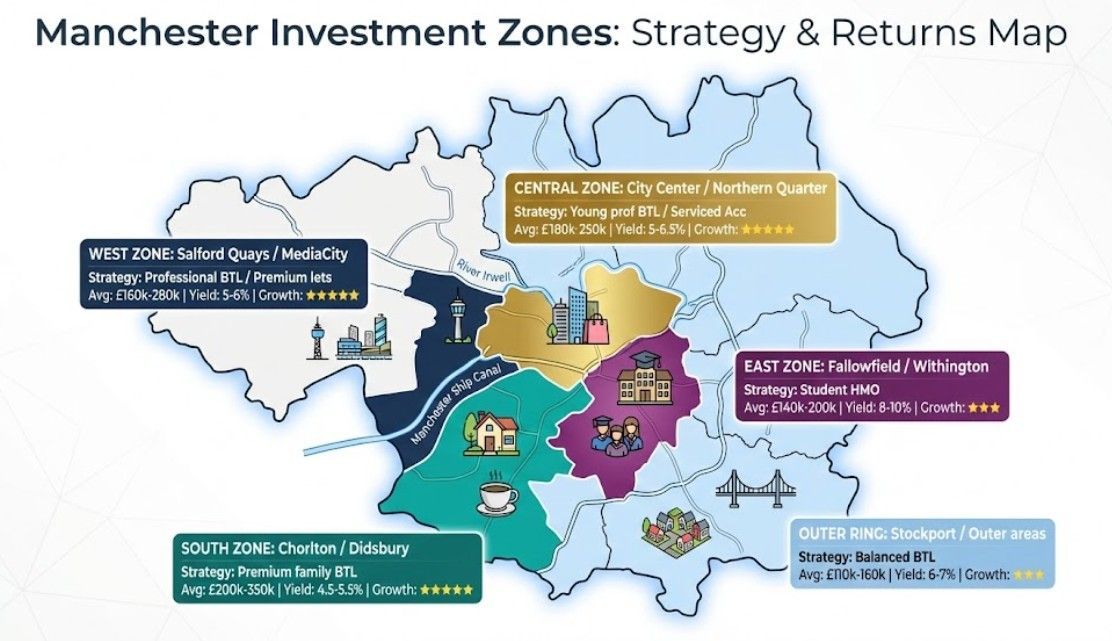
Manchester city center offers apartments in modern developments targeting young professionals, students, or serviced accommodation guests. Purchase prices typically range £150,000-£250,000 for one or two-bedroom units, delivering gross yields around 5-6.5% for standard lets, potentially higher for serviced accommodation strategies.
The Northern Quarter attracts creative professionals and provides strongest serviced accommodation potential given its bars, restaurants, and cultural appeal. However, substantial new apartment supply continues entering the market, requiring careful analysis ensuring demand absorption keeps pace with development.
City center investment suits investors comfortable with leasehold complications, service charges (often £1,500-£2,500 annually), and markets where oversupply risks exist. Capital growth prospects remain solid given Manchester's ongoing economic expansion, though rental yield moderation reflects premium purchase prices.
Salford Quays and MediaCity
Salford Quays transformed from derelict docks into premium residential and commercial district anchored by MediaCity's major employer presence. Modern apartments command £160,000-£280,000, attracting professionals working locally or commuting to city center.
The area demonstrates Manchester's regeneration success but faces similar oversupply considerations as city center—numerous developments continue adding units to rental markets. Properties near MediaCity itself maintain stronger demand than peripheral Salford Quays locations trading primarily on proximity rather than immediate amenity access. Salford's regeneration trajectory mirrors Birmingham's city centre transformation, attracting young professionals through modern developments near employment clusters and improved transport links.
Service charges and ground rents require particular scrutiny in newer Salford developments, occasionally reaching levels that significantly impact net returns despite attractive gross yields.
Chorlton and Didsbury (South Manchester)
These affluent southern suburbs represent Manchester's premium family rental markets. Victorian and Edwardian houses cost £200,000-£350,000, delivering modest gross yields (4.5-5.5%) but attracting exceptionally stable, quality tenants and demonstrating consistent capital appreciation.
Didsbury particularly appeals to professionals and families prioritizing excellent schools, green spaces, and village-feel community whilst maintaining convenient city center access. Tenancies frequently extend multiple years, and properties let rapidly with minimal void periods.
These areas suit investors prioritizing capital preservation and tenant quality over maximum rental yields, accepting lower immediate returns in exchange for minimal management and strong long-term value protection.
Fallowfield and Withington (Student Areas)
Areas surrounding University of Manchester and Manchester Metropolitan support substantial student accommodation demand. Terraced houses suitable for HMO conversion typically cost £140,000-£200,000, potentially delivering 8-10% gross yields when fully tenanted.
Student market dynamics mirror Nottingham—September-focused letting cycles, summer void management, higher tenant turnover, and intensive property management. Council licensing requirements apply, and competition for student tenants intensifies when multiple properties market simultaneously.
These areas suit experienced investors comfortable managing student properties or those using professional student letting specialists handling the operational complexities.
Stockport and Outer Areas
Greater Manchester's outer areas—Stockport, parts of Oldham, some Bury locations—provide more affordable entry points (£110,000-£160,000) whilst maintaining Manchester connectivity through excellent transport links.
Stockport particularly offers balanced opportunities—reasonable property prices, decent yields (6-7%), and mixed professional/family tenant demographics. The town benefits from direct rail services to Manchester and London, supporting commuter demand alongside local employment.
These peripheral areas suit investors wanting Manchester exposure without city center or premium suburb pricing, accepting slightly lower growth prospects in exchange for superior immediate yields and affordability.
Which INVESTMENT Strategy Works in Manchester
Manchester's market diversity supports virtually all residential investment approaches, with optimal strategy selection depending on capital availability, growth priorities, and management preferences.
City Living Buy-to-Let
Modern city center apartments suit young professionals prioritising convenience, nightlife access, and minimal commute times. One-bedroom units generate £900-£1,200 monthly; two-bedrooms achieve £1,200-£1,600. Tenant turnover runs higher than suburban family markets—average tenancies last 12-18 months versus 24+ months in family areas - but demand depth ensures rapid re-letting when properties are priced competitively.
Success requires understanding apartment market nuances - service charges, building quality variations, and oversupply risks in specific developments. Properties in established buildings with proven management often outperform newer developments promising premium specifications but delivering mixed quality. Manchester's diverse professional employment base creates strong demand across property types. Leeds offers similar professional tenant demographics within Yorkshire, allowing investors to build diversified Northern portfolios.
Serviced Accommodation
Manchester generates substantial business travel and tourism, creating viable serviced accommodation markets in city center and Northern Quarter locations. Returns potentially reach 10-15% annually when occupancy rates stay strong, though this strategy demands active management or professional serviced accommodation operators handling bookings, cleaning, and guest communications.
Regulatory scrutiny continues increasing - some developments now restrict short-term letting, and planning permissions occasionally require specific approval for serviced accommodation use. Verify any property's serviced accommodation permissibility before committing to this strategy.
Traditional Suburban Buy-to-Let
Family homes in areas like Stockport, Chorlton, or parts of Salford provide straightforward rental investments to stable tenant demographics. Strategy mirrors Derby's simplicity whilst benefiting from Manchester's stronger growth fundamentals and employment diversity.
Properties achieve lower gross yields (5-6.5%) than Midlands equivalents but offer superior capital appreciation potential. Investors balancing immediate income requirements against long-term wealth building find this strategy optimal within Manchester context.
Student HMO Investment
University areas support HMO strategies delivering 8-10% gross yields with established student demand patterns. Management intensity and licensing requirements mirror Nottingham's student markets - requiring understanding academic calendars, handling group tenancies, and navigating council licensing processes.
Manchester's substantial student population (over 100,000 across both universities) provides demand depth, though competition for quality student properties remains fierce during peak letting seasons.
Manchester Investment Performance
Typical Returns Across Strategies
City center apartment (£180,000 purchase):
- Monthly rent: £1,000-£1,300
- Gross yield: 5.5-6.5%
- Net yield: 3-4%
- Capital growth: 5-7% annually (historical average)
Suburban family home (£160,000 purchase):
- Monthly rent: £950-£1,150
- Gross yield: 6-7%
- Net yield: 3.5-4.5%
- Capital growth: 4-6% annually
Student HMO (£170,000 purchase, 5 rooms):
- Monthly rent: £1,400-£1,700
- Gross yield: 8-10%
- Net yield: 5-7%
- Capital growth: 3-5% annually
Growth Drivers
Manchester's appreciation prospects stem from sustained infrastructure investment, employment growth, and ongoing regeneration. HS2 connections (despite delays and controversies) will eventually reduce London journey times to just over one hour, strengthening Manchester's appeal to businesses and residents seeking London accessibility without London costs. Planned HS2 connections strengthen Manchester's national position, with improved journey times benefiting surrounding areas. Sheffield's connectivity to Manchester creates spillover opportunities as professionals seek affordable alternatives within commutable distance.
The Northern Powerhouse initiative, whilst politically contentious, has delivered tangible investment in transport, commercial development, and residential regeneration. Airport expansion continues supporting both tourism and business connectivity. These fundamentals suggest Manchester's growth trajectory remains positive despite economic uncertainties. Manchester historically delivers 5-7% annual capital growth during stable periods, substantially exceeding Derby's 2-4% appreciation rates whilst requiring considerably higher initial capital investment.
Market Maturity Considerations
Manchester's success has attracted substantial investor attention, reducing the "undiscovered bargain" opportunities that existed a decade ago. Quality properties now sell quickly, often receiving multiple offers. Competition requires decisive action when suitable opportunities arise, though this urgency shouldn't override thorough due diligence.
Some areas face genuine oversupply risks—particularly city center apartments where development pace has exceeded absorption capacity in certain price points. Careful development-specific and location-specific analysis prevents investing in saturated micro-markets within broader strong demand areas.
Manchester's Investment Case
We recommend Manchester for investors whose priorities align with the city's particular strengths - sustained capital growth, major city diversification, and tolerance for higher entry costs and market complexity.
Manchester demonstrates genuine economic substance beyond property speculation. Major employers continue expanding or relocating to the city. Population growth remains positive as young professionals migrate from other UK regions and internationally. Cultural and lifestyle appeal strengthens Manchester's positioning competing with London for talent and businesses.
The city's resilience through various economic cycles provides confidence in long-term fundamentals. Manufacturing decline didn't destroy Manchester - it adapted, evolved, and rebuilt around knowledge economy sectors demonstrating durability.
For investors building substantial portfolios, Manchester exposure provides geographic and economic diversification from Midlands concentrations. The city's different economic drivers and tenant demographics complement rather than duplicate Nottingham or Derby holdings. High-yield opportunities exist but require considerable due diligence. Unlike Nottingham's concentrated student areas where HMO strategies follow established patterns, Manchester demands more sophisticated market analysis across diverse neighborhoods.
Invest in Manchester Property
Manchester's competitive market requires local expertise and strong sourcing relationships. Our property deal sourcing network identifies opportunities across Greater Manchester before they reach major portals, screening for optimal locations and genuine value.
Whether you're attracted to city center growth potential, suburban stability, or student market yields, we provide comprehensive analysis matching Manchester opportunities to your specific objectives.
FAQs ABOUT MANCHESTER property investment
Is Manchester better than Birmingham for property investment?
Manchester and Birmingham serve similar investor profiles—both offer major city exposure, strong growth prospects, and diverse strategies. Manchester demonstrates slightly stronger historical capital appreciation (5-7% versus Birmingham's 4-6%) and superior infrastructure investment visibility. Birmingham provides marginally better affordability (properties £10,000-£30,000 cheaper on average) and geographic centrality. Both cities face apartment oversupply considerations in specific developments. Choose Manchester for maximum growth focus and willingness to accept premium pricing. Choose Birmingham for slightly better affordability whilst maintaining major city fundamentals. Many sophisticated investors maintain properties in both cities within diversified portfolios.
What about Manchester apartment oversupply concerns?
Manchester city center has experienced substantial apartment development over recent years, creating genuine oversupply in specific price points and developments. However, this isn't universal—quality apartments in established buildings with good management continue letting successfully, whilst some newer developments struggle with void periods or require rental discounting. Avoid investing in developments with excessive available units or areas showing clear tenant demand softening. Focus on established locations, proven developments, and price points demonstrating consistent absorption. Our sourcing service explicitly monitors supply-demand dynamics, screening out developments facing saturation issues before presenting opportunities.
Can I use serviced accommodation strategies in Manchester?
Manchester generates substantial serviced accommodation demand from business travel and tourism, making the strategy viable in appropriate locations—primarily city center, Northern Quarter, and near major business districts. However, regulatory environment continues tightening. Some leasehold developments now explicitly prohibit short-term letting. Planning permissions occasionally require specific serviced accommodation approval. Always verify any property's serviced accommodation permissibility through thorough lease review and planning checks before committing to this strategy. When permitted, Manchester serviced accommodation can deliver 10-15% annual returns, though this requires active management or professional operator involvement handling bookings, cleaning, and guest communications.
How does Manchester compare to London for investment?
Manchester offers substantially superior rental yields (5-7% versus London's 3-4%) and dramatically lower entry costs (£140,000-£220,000 typical versus £400,000-£600,000+ in London). London historically demonstrates stronger capital appreciation, though Manchester's growth (5-7% annually during positive periods) remains solid and sometimes matches or exceeds London depending on specific timeframes and locations. For investors prioritizing rental income and cash flow, Manchester proves significantly more effective. For those with substantial capital accepting minimal current yields whilst targeting maximum long-term value appreciation, London retains advantages despite higher costs. Most investors without £100,000+ deposits find Manchester far more accessible and financially viable than London investment.